The 2026 AI Automation Tool Stack Businesses Are Actually Buying
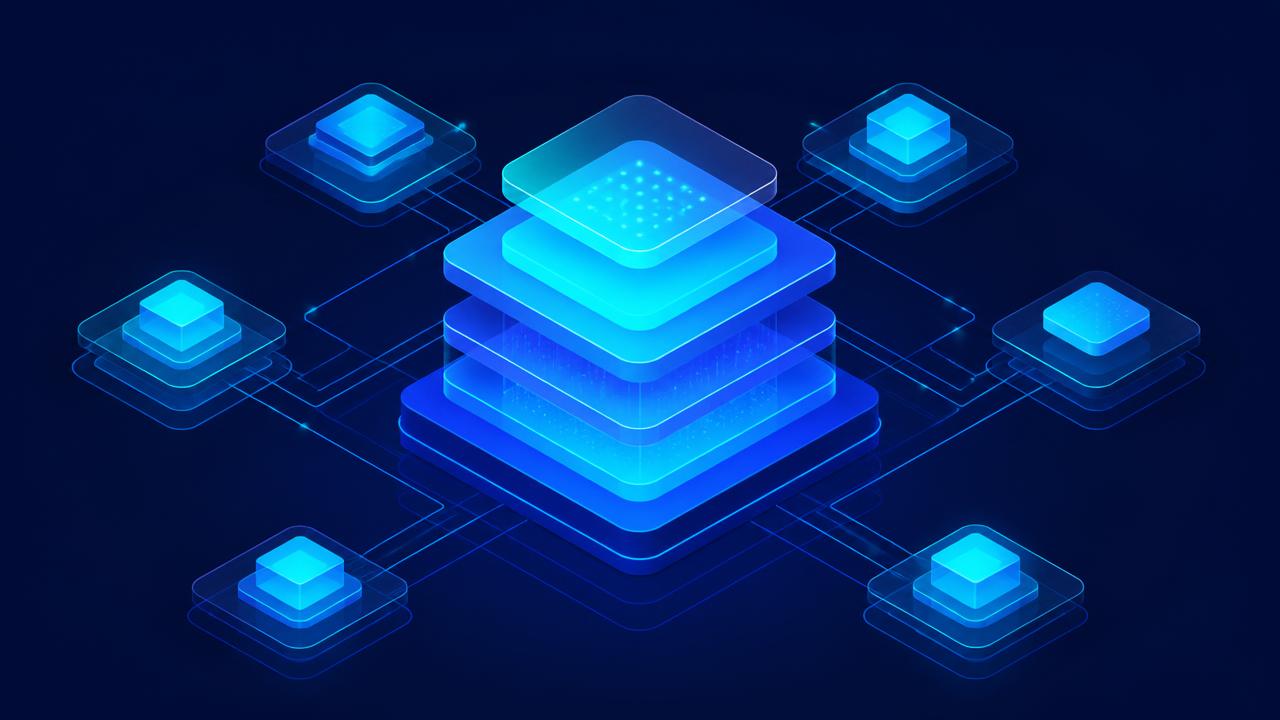
The AI tooling market has consolidated into recognisable layers. Two years ago every vendor claimed to do everything; in 2026 buyers can draw a clean architecture diagram and know which layer solves which problem. That clarity is what has moved AI automation from experiment to budget line in mid-market businesses.
This article walks the stack from the bottom up — models, retrieval, agents, document AI, voice, orchestration and observability — and explains, for each layer, what it is for, what it costs you if you skip it, and the mistakes that create rework later.
Layer 1: Models — A Commodity You Should Be Able to Swap
Frontier and open-weight models are now close enough in capability for most business tasks that model choice is an economics and latency decision rather than an identity. The practical implication is architectural: route through an abstraction so you can change models without rewriting workflows. Businesses that hard-wired one vendor in 2024 spent 2025 undoing it.
Use larger reasoning models for judgement-heavy steps such as contract analysis or exception handling, and smaller fast models for classification, extraction and routing. The cost difference across a million monthly tasks is material, and users notice latency far more than they notice marginal quality.
Layer 2: Retrieval and Knowledge — Where Accuracy Comes From
Nothing improves AI output more than grounding it in your own material. Retrieval-augmented generation over your policies, product data, prior cases, pricing rules and contracts is what turns a plausible answer into a correct one, and it is the difference between a demo and a system employees trust.
The work here is unglamorous: source-of-truth selection, chunking, permissions, freshness and evaluation. Permission-aware retrieval in particular is non-negotiable — an assistant that can surface documents a user should not see is a data incident, not a feature.
- Ground every answer in cited internal sources
- Enforce the same access rules the source systems enforce
- Re-index on change, not on a monthly schedule
Layer 3: Agent Frameworks — From Chat to Action
Agentic AI is the layer that took the biggest step forward. An agent plans a sequence of steps, calls tools such as your CRM, ERP or email system, checks its own output, and escalates when confidence is low. That is qualitatively different from a chatbot that only answers.
The design pattern that works in production is narrow agents with explicit tool permissions and hard limits, coordinated by deterministic workflow. Broad, open-ended autonomy demos well and fails in audit. Give each agent one job, a small tool set, a budget of steps and a defined escalation path.
Layer 4: Document AI and Intelligent Document Processing
Most business friction is still paper-shaped: invoices, claims, KYC packs, bills of lading, resumes, court filings, purchase orders. Modern document AI reads mixed-quality scans, understands layout, extracts structured fields and reconciles them against source systems, with confidence scores per field.
This layer usually produces the clearest financial case because the current cost is visible as headcount hours per thousand documents. Design the exception queue first: the value is not in the ninety percent the AI handles, it is in how cleanly the remaining ten percent reaches a human with the right context.
Layer 5: Voice and Conversation
Real-time voice agents crossed the usability threshold. Latency is low enough and interruption handling good enough that customers complete routine calls without frustration — appointment scheduling, payment reminders, order status, first-line qualification and triage.
Adopt it where call volume is high and intent is narrow, keep a one-word path to a human, and record everything for quality review. Voice is also the layer with the most regulatory surface, so disclosure and consent handling belong in the design, not in a later compliance review.
Layer 6: Orchestration — The Layer Buyers Underestimate
Orchestration connects models, retrieval, agents and your systems of record into an end-to-end process with retries, approvals, audit trails and SLAs. Without it, you have a collection of assistants; with it, you have automation.
The rule of thumb that holds up in production: deterministic where correctness is defined, AI where judgement is required. Approval thresholds, ledger writes, notifications and state transitions should be code. Classification, drafting, summarisation and prioritisation should be AI. Blurring that line is the most common cause of automation that nobody trusts.
Layer 7: Observability, Evaluation and Governance
You cannot operate what you cannot measure. Production AI needs logged inputs and outputs, per-step traces, cost and latency metrics, quality evaluation against a labelled set, and drift alerts when behaviour changes after a model or prompt update.
Governance sits alongside it: who approved this workflow, what data does it touch, what is the human review policy, and how is a bad output reported and corrected? Businesses that put this in place early scale faster later, because each new use case inherits the controls instead of re-litigating them.
What Mid-Market Teams Actually Buy First
The common first purchases in 2026 are narrow and operational: an AI agent for inbound response, document AI for one high-volume form type, and orchestration to connect them to the CRM or ERP. Voice follows once the first two are stable. Full custom model work remains rare and is usually unnecessary.
Buy versus build has also settled. Buy the layers that are commoditised — models, voice infrastructure, base orchestration. Build the parts that encode your specific process, pricing and compliance rules, because that is where your advantage is and where no vendor understands your business.
Getting the Stack Implemented
Wingspan Global Solutions builds and runs this stack for clients across the USA and India — choosing the layers you need, integrating them with your existing systems, and operating them with human-in-the-loop review. Most engagements begin with one process, a measured baseline and a fixed first phase.
Frequently Asked Questions
Do we need our own AI model?
Almost never. Grounding a commercial or open-weight model in your own data with good retrieval produces better business results than training a model, at a fraction of the cost and time.
What is the difference between RPA and agentic AI?
RPA repeats fixed, brittle steps against screens and files. Agentic AI interprets unstructured input, decides between options and calls tools, so it survives variation that would break a scripted bot.
How long does a first AI automation project take?
A well-scoped first workflow typically reaches production in four to eight weeks, including integration and a human review process.
Related AI automation services
Talk to us about implementing AI automation
Wingspan Global Solutions implements AI agents, sales automation and document automation for businesses in the USA and India — with human-in-the-loop review and measured results.